How much of your gross revenue should be allocated to ad spend?
Your marketing budget should not just be based on revenue.
It should be based on the role marketing needs to play in your business right now.
I have been involved in a variety of businesses from startup SaaS (software as a service and manufacturing) to mature businesses (professional services) to businesses trying to reinvent themselves (engineering and manufacturing). In most cases, the investment that is made in a business in advertising, marketing and sales determine the growth trajectory.
As I tell any new company or startup...be prepared to bleed cash. Every time you turn around, there is another bill to pay. And most of the time, you can't pay yourself. The formulas and references are a starting point but in the first year, it is very difficult to know what your revenue will be. After that first year, you feel like you are just treading water and doing everything yourself to save a buck.
Why should a business change its advertising strategy as it grows?
A common mistake many companies make is maintaining the same advertising strategy throughout their entire lifecycle.
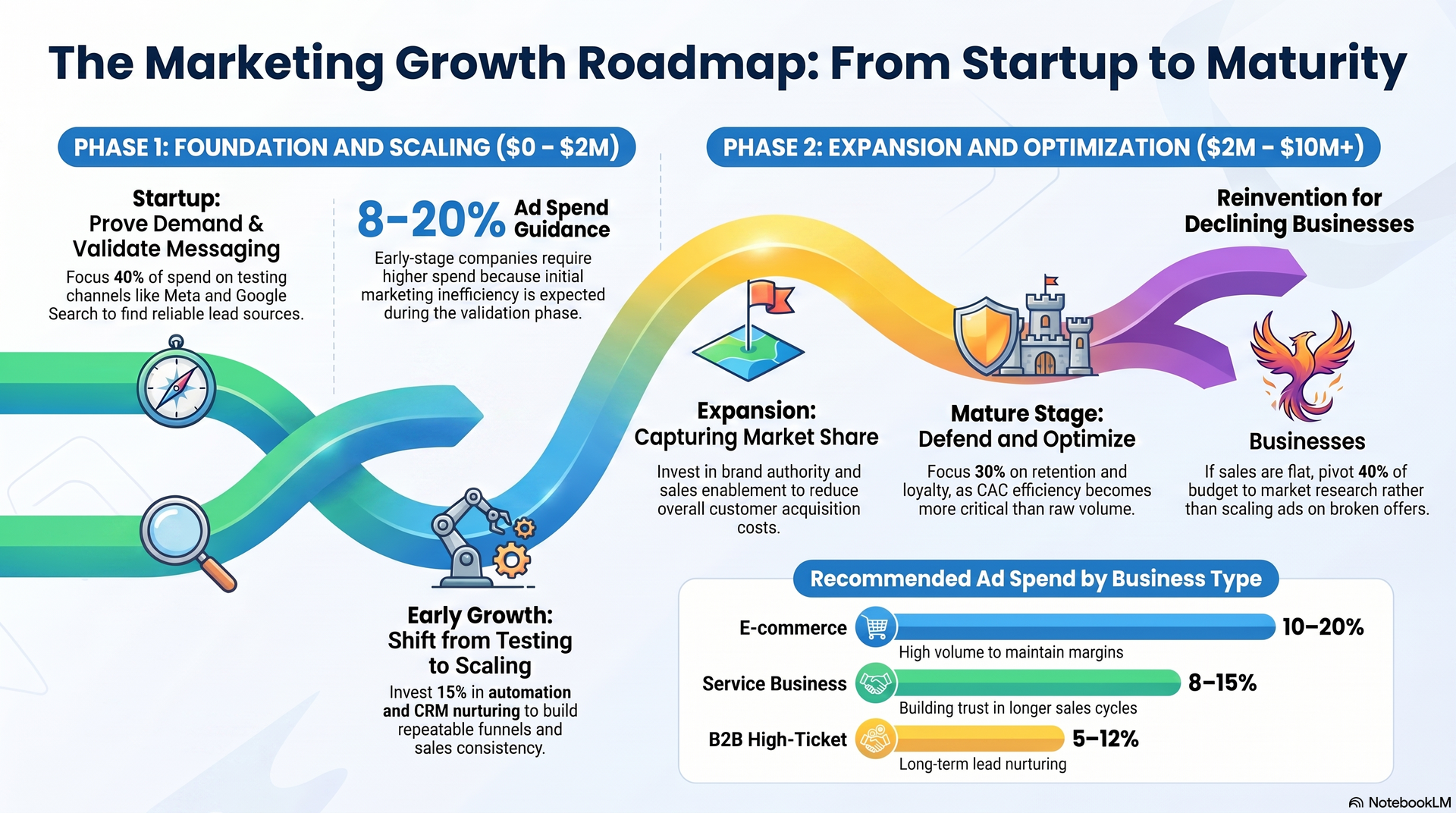
However, different business stages require distinct marketing priorities. In the early stages, the focus is on proving demand and identifying messaging that converts. As a company matures, the focus shifts toward scaling what works, capturing market share, and eventually defending a market position through efficiency and brand loyalty.
How much of our gross revenue should be allocated to ad spend?
The percentage of revenue allocated to advertising varies significantly based on the business stage and the industry. Generally, younger companies must spend a higher percentage of revenue to overcome inefficiency and establish a presence, while mature companies can often lower their percentage as brand authority begins to reduce acquisition costs.
| Business Stage | Typical Ad Spend (% of Revenue) | Primary Goal | Approximate Revenue |
|---|---|---|---|
| Startup/Validation | 8% to 20% | Prove demand and identify converting messages | $0-$500K |
| Early Growth | 7% to 12% | Double down on proven acquisition | $500K-$2M |
| Expansion | 5% to 10% | Gain market share and build brand authority | $2M-$10M |
| Mature/Plateau | 3% to 8% | Defend position and optimize efficiency | $10M+ |
| Decline/Reposition | Temporary Increase | Reinvention and new offer testing | Identify a go/no-go. |
Stage-Specific Guidance
What is the focus during the Startup / Validation Stage (0–500k)?
In this stage, inefficiency is expected. The primary objective is to find the cheapest reliable lead source through narrow targeting and fast testing cycles.
- Budget Allocation: 40% on testing channels (e.g., Meta, Google, local sponsorships), 30% on brand credibility (website, reviews), 20% on content, and 10% on retargeting.
- Key Metrics: Cost per lead, sales cycle length, and offer resonance.
- Strategy: Utilize simple offers and heavy founder-led content.
A simple offer clearly communicates what you're selling, who it's for, and why someone should care. It avoids multiple products, complicated pricing, or too many choices.
Examples:
- SaaS startup: "Start your free 14-day trial. No credit card required."
- Marketing agency: "Free 30-minute marketing strategy session."
- Manufacturer: "Schedule a live machine demo."
- Consultant: "Book a free website audit."
By consistently sharing expertise, insights, and the story behind the business, founders create authentic connections that help differentiate their company in a crowded market.
How does the strategy shift during Early Growth (500k–2M)?
The focus moves from asking "What works?" to "What scales?" At this stage, referrals are often no longer enough to sustain growth, necessitating predictable lead generation.
- Budget Allocation: 50% on proven acquisition channels, 20% on content, 15% on retargeting, and 15% on automation/CRM nurturing.
- Strategy: Scale winning campaigns, eliminate underperforming ones, and begin measuring Lifetime Value (LTV). Companies should focus on niche positioning and building authority content.
Once a company has identified the marketing strategies that consistently generate leads and sales, it should invest more resources into those successful campaigns while reducing or discontinuing efforts that produce little return. At this stage, businesses should also begin measuring Customer Lifetime Value (LTV); the total revenue a customer is expected to generate throughout their relationship with the company. Understanding LTV helps determine how much can be profitably spent to acquire new customers and where marketing investments will have the greatest long-term impact.
As the business grows, it should also strengthen its niche positioning by clearly defining the specific market or audience it serves best rather than trying to appeal to everyone. Becoming known for solving a particular problem helps differentiate the company from competitors. To reinforce that position, businesses should create authority content; high-quality educational resources such as articles, videos, webinars, case studies, and industry insights that demonstrate expertise, build trust, and establish the company as a credible leader in its field.
What changes when a company enters the Expansion Stage (2M–10M)?
During expansion, the goal is market share. A significant shift occurs where brand authority begins to lower the cost of customer acquisition.
- Budget Allocation: 40% on direct response, 25% on brand authority, 20% on sales enablement, and 15% on retention.
- Strategy: Add new channels, expand geographically, and align sales teams.
- Common Pitfalls: Companies often over-invest in short-term paid ads while underinvesting in long-term assets like SEO, PR, thought leadership, and high-production video.
How should a Mature or Plateaued business ($10M+) manage spend?
In this stage, Customer Acquisition Cost (CAC) matters more than sheer volume. The goal is to defend the market position and optimize for efficiency.
- Budget Allocation: 30% acquisition, 30% retention, 20% brand, and 20% innovation/testing.
- Strategy: Raise average customer value, strengthen loyalty, and increase referral rates.
Raising average customer value involves increasing the amount each customer spends through strategies such as upselling, cross-selling complementary products or services, premium offerings, or subscription programs. Strengthening loyalty means creating positive customer experiences that encourage repeat business through exceptional service, personalized communication, loyalty programs, and ongoing support. Finally, increase referral rates by encouraging satisfied customers to recommend the business to colleagues, friends, or family through referral incentives, testimonials, case studies, and word-of-mouth marketing.
What is the approach if a business is in the Decline or Repositioning Stage?
If sales are flat and margins are shrinking, the primary goal is reinvention.
- Budget Allocation: 40% market research, 30% new offer testing, 20% customer reactivation, and 10% brand refresh.
- Primary Rule: Do not scale advertising on a broken offer. Fix the positioning (how they differentiate themselves), target audience (who they serve), value proposition (why customers should choose them), and offer structure (what they are selling and how it is presented).
Budgeting by Business Type
How does the industry affect these spend recommendations?
While the growth stage is the primary driver of strategy, the nature of the business also influences the baseline budget:
- Service Businesses (8–15%): Higher initial spend is required because sales cycles are trust-heavy and require more touch points.
- E-commerce (10–20%): Spend is often higher because profitability and margins are strictly dependent on high sales volumes.
- B2B High-Ticket (5–12%): Requires a moderate, consistent spend to manage longer nurturing cycles.
- Local Businesses (3–10%): Efficiency and local relevance matter more than broad market reach.

From our perspective, we see customers with great products or services but they can't grow because they don't want to spend money on ads, SEO, video production, posting, etc. In some cases, their customer's price does not have enough margin to allow for marketing and advertising spends. Then they have a problem...continue doing business at a lower volume with lower customer prices. In many cases, their sales are so low that they end up working for "free".
For manufacturers of a product, this is a challenge. Higher volume production typically decreases the overall cost, but your sales volume isn't enough to increase production. If you sell a product, make sure you develop the price with a profit goal that includes a realistic budget for marketing and advertising.
Summary: Marketing and Advertising Strategy for Stages
Every business moves through stages. In the startup stage, marketing proves demand. In growth, it creates predictability. In expansion, it builds authority. In maturity, it protects momentum. And when sales slow down, marketing helps reposition the business for what comes next.
At Marketing Angle, we help businesses invest in the right marketing strategy for the stage they are actually in, not the stage they wish they were in.